How to write a character profile (with a template)
A character profile isn’t a form to fill in. It’s a way to find out who someone is before they surprise you on the page. Skip the questions that don’t change the story, and spend your time on the ones that do.
The questions that matter
What do they want?
The goal they chase on the page: to win the race, to find their sister, to be left alone. A clear want gives every scene with them a direction.
What do they need?
Often different from what they want: to forgive, to ask for help, to stop running. The gap between want and need is where most character arcs live.
What’s their flaw?
The habit or belief that keeps getting them into trouble. Good flaws come from something real: a fear, an old wound, a lesson learned the wrong way.
What happened before page one?
Backstory is useful only when it explains behaviour. You don’t need their whole childhood, just the two or three events that shaped how they act now.
Who matters to them?
Relationships reveal character faster than description. Who do they protect, resent, owe, or lie to?
How do they change?
Where do they start, and where do they end? Writing the arc in two sentences keeps the middle of the book honest.
What do we see and hear?
A few specific details beat a full description: the coat they never take off, the way they answer a question with a question. Pick details that say something about who they are.
A template you can copy
| Field | Example |
|---|---|
| Name | Elin Varga |
| Role | Lighthouse keeper’s daughter, the main character |
| Age (start / end) | 17 / 18 |
| Appearance | Salt-stiff hair, her father’s oilskin coat, rope-burned hands |
| Personality | Stubborn, dry humour, hates being helped |
| Backstory | Mother drowned when Elin was nine; raised by a father who doesn’t talk |
| Goal | Keep the light burning until her brother’s ship is home |
| Relationships | Protective of her brother; resents the harbour master |
| Flaw | Would rather fail alone than succeed with help |
| Arc | Learns that asking for help isn’t the same as giving up |
Tip: write a short scene that isn’t in the book: your character waiting for a late train, or losing an argument. If you can’t write it, the profile is missing something.
Character sheets in Storywriting
Every project has a Characters section with a sheet for each person in your story. The sheet has the fields above: role or occupation, importance, gender, age at the start and end of the story, appearance, personality, backstory, goals, relationships, flaws, arc and notes. Fill in only what helps; empty fields stay out of the way.
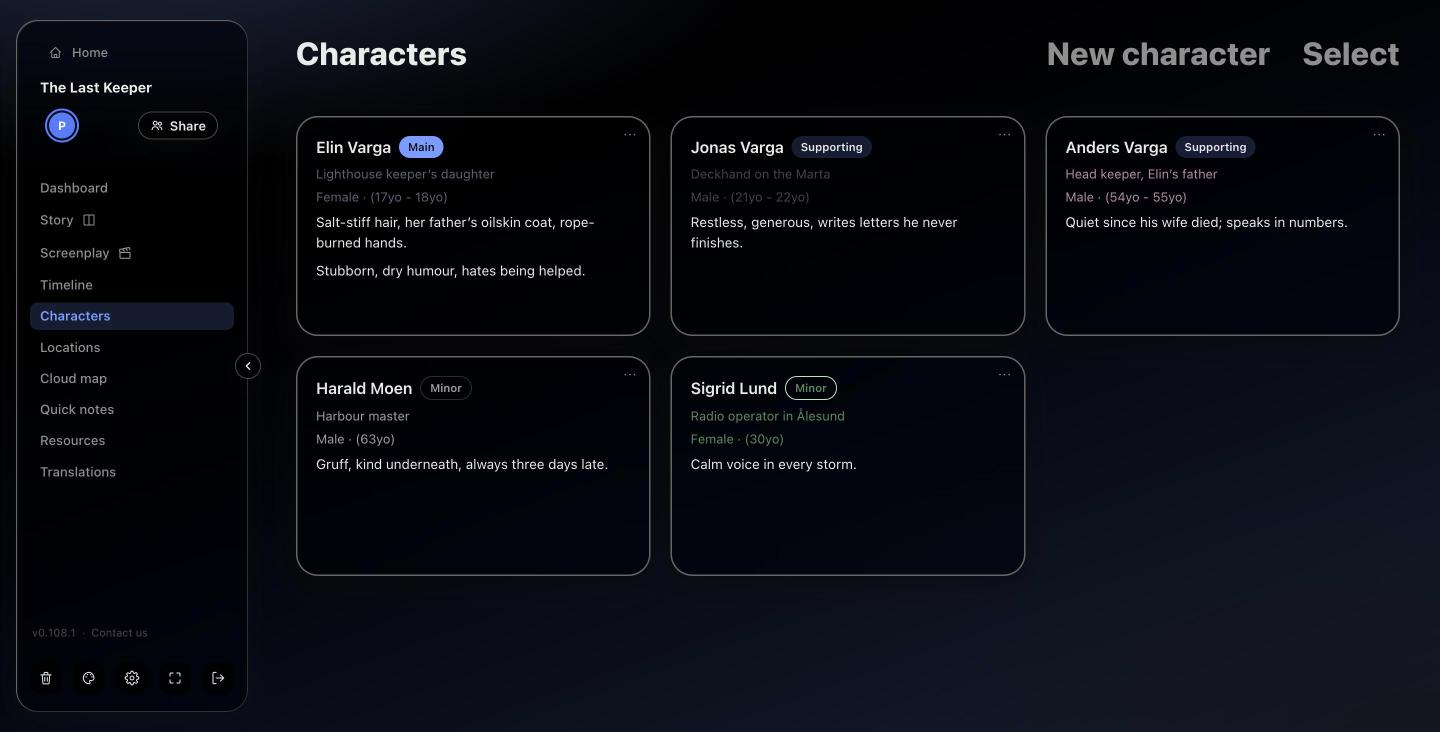
Characters are shared by the story and the screenplay of a project, and you can link them to events on the timeline to see where each one is at any moment.