How to keep track of your story’s timeline
Readers notice timeline mistakes: a character who is twelve in chapter two and fifteen a year later, a journey that takes three days one way and a week back. A simple timeline, kept up to date, catches them before anyone else does.
Story order and real order
Your book tells events in one order; they happened in another. Flashbacks, parallel storylines and “meanwhile” chapters all depend on keeping the two apart. A timeline is the real order, in one place, whatever order you tell it in.
A simple method
- List the main events, in the order they happen, not the order you tell them.
- Give them a time: a real date if your story has them, or a relative one (“day 1”, “the second winter”).
- Group them into periods: a war, a school year, a voyage. Periods make the shape of the story visible.
- Add the quiet facts: birthdays, travel times, seasons, a moon phase if it matters.
- Check every “later”. Whenever the text says “two weeks later” or “that summer”, check it against the line.
What to watch for
- Ages. Work out every main character’s birth year once and derive ages from it.
- Travel. How long does it really take to get from one place to another, on foot, by horse, by ship?
- Seasons and daylight. A December evening is dark by five in much of the world.
- Things happening at the same time. Two storylines running in parallel need to line up when they meet.
- Pregnancies, injuries and healing. These take real time, and readers know it.
Timelines in Storywriting
Each project can have as many timelines as you need (one for the main story, one for a family’s history, for example). On a timeline:
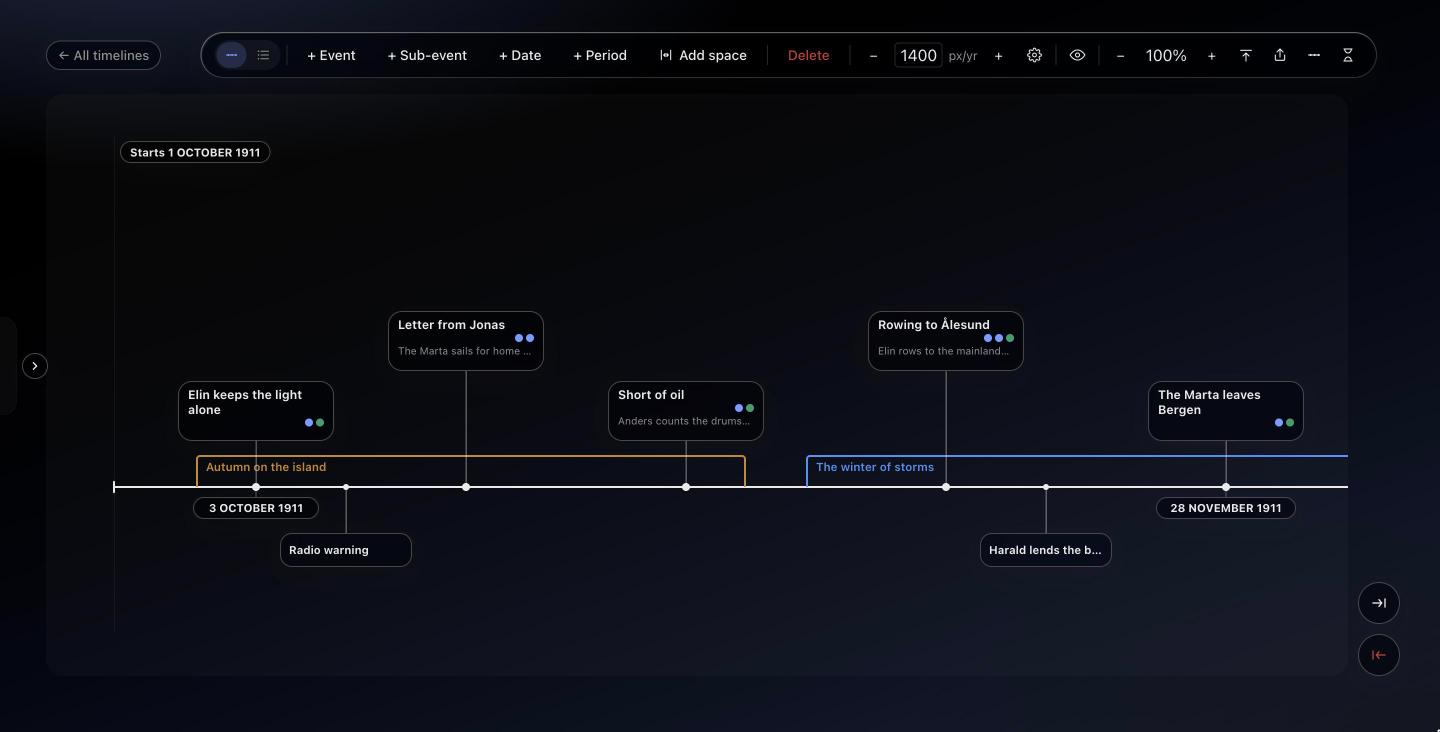
- Events sit above the line and sub-events below it; you place them freely and they stay where you put them.
- Periods span a stretch of the line, and dates mark exact moments.
- Give the timeline a start date and the ruler shows real years.
- Drop one event onto another to stack them: things that happen at the same time, still in order.
- Link characters and places to events, then filter to see only one character’s path.
- Switch to the list view to read the timeline like a summary, with “about 3 years later” between events.
You can export a timeline as a PDF, a Word file or plain text, and every change is kept in its version history.
Tip: put the turning points of your outline on the timeline first. The rest of the events find their place around them.